
When I first started looking into things to do in Seoul, I read about War Memorial of Korea. Being a student of history and having done a good amount research on war memorials and commemorations, I put it on the top of my to see list.
The War Memorial of Korea is located in Yongsan-dong; at former the Korean Infantry headquarters site and across from the Republic of Korea’s Ministry of Defense office. The War Memorial site includes a museum, outdoor display space of military vehicles and monuments and statues representative of wartime, pursuit of peace and memory of the fallen. The Memorial opened in 1994 to commemorate those participated in the war that lead to the modern nation state. The memorial is the largest of its kind in the world. By far it was one of most amazing war memorials / museums I have recently visited.

Statue of Brothers
I knew I had arrived at the War Memorial when I spotted the Statue of Brothers monument. Without a doubt, this is one of the most impressive pieces on the grounds.
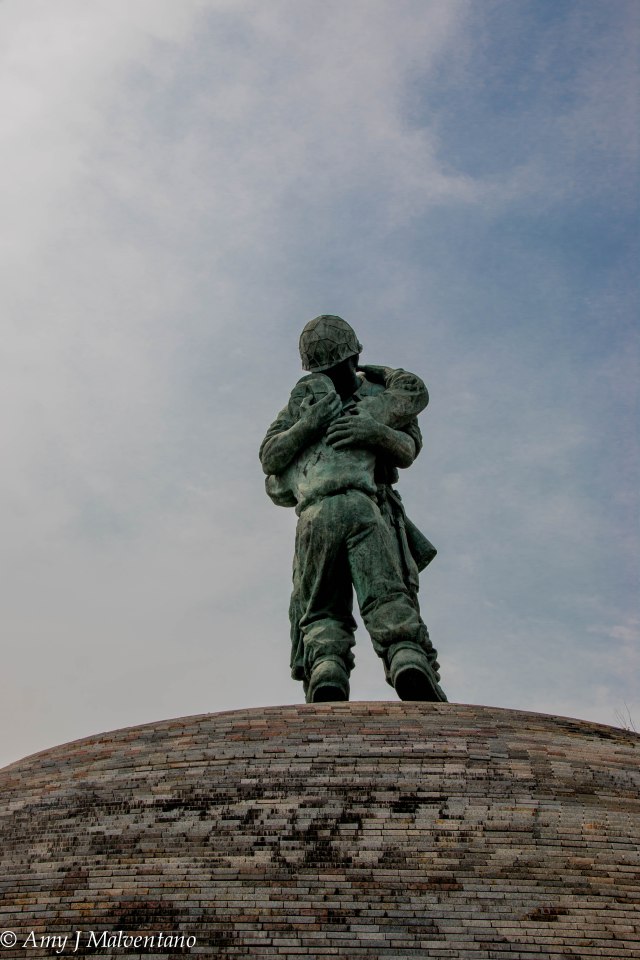
The monument consist of inner and outer portion. The upper (outer) part depicts two soldiers in a desperate embrace as they stand on a split dome landscape. The nearby panel tells the fictional story of two brothers meeting in battle during the Korean War: the elder an officer of the Republic of Korea (South Korea); the younger a North Korean soldier. As they recognise their fraternal love and reconcile, the statue symbolises the desire of the two peoples of Korea for reunification, while the cracked dome represents their ongoing division.

The tomb-shaped dome was built with pieces of granite collected from across South Korea, symbolizing the sacrifices made by our patriots. The crack in the dome stands for the division of Korea and the hope for reunification. Inside the dome is mosaic wall of paintings that expresses the spirit of the Korean people to overcome the national tragedy.


Tower of the Korean War and Defending the Fatherland
In the center of memorial park alined with the entrance to the museum is the Tower of Korea War.

The Tower of Korea War symbolizes a bronze sword and the tree of life. The sword represents the time honored history and the warrior spirit. The tree of life symbolizes the prosperity and peace of the Korean people. The Tower is surrounded by the bronze statues known as Defending the Fatherland. Defending the Fatherland, includes 38 people from all walks of life defending Korea. The bronze statues depict the suffering and pain of the Korean people, caused by the war while embodying the sublime spirit of sacrifice and dedication to the defence of the fatherland of past patriots.


Remembering the Fallen
On both sides of the exterior of the museum are plaques honoring those who gave their lives in conflicts. The memorials to the right are many of Koreans while the memorials to the left are memorials for soldiers from other countries who gave their lives while fighting for Korea.


There are also several other small monuments which is dedicated to the memory those who gave their lives for Korea and for peace.


Combat Vehicles and Military Equipment
After you get past the memorials, to the right of the museum is a wide array of military planes, helicopters, tanks, rockets, gun batteries, launchers and a ship. I believe there is over 150 items on display. Many of the planes are equipped with ladders, which all you to peak into the cockpit of the planes or sit in the seats on top of the tanks. Equipment is not only from South Korea but also from both American and Soviet sides, which helped with combat in the area.


Museum
The museum was a huge surprise. I did not expect to find it as informational and interesting as I did. I honestly expected it to mostly on the Korean War and a continuing memorial to those that perished in war. Instead, a well developed and interactive exhibits takes you on a journey through the history of South Korea. When you enter the museum you enter on the second floor. The second floor is dedicated to the memory of patriots involved in past war efforts. Included on this floor is a moving memorial exhibit. It is probably one of most moving national memorials I have visited. Also on this floor are several statues, mural and exhibits celebrating the culture and history of Korea.


If you want to start the exhibits in historical order, you will need to go down to the first floor. In the exhibit area called “War History” you learn about the history of Korea from the prehistoric era to the Japanese colonial period. Military remains, relics, and documents are on display as well. Among them are war and victory records, ammunition, the Turtle Ship.


As you move upward you will next learn about the Korean War; the background, progression and how a truce occurred. Exhibit included ammunition, information on major battles, and artifacts from people displaced by the war.Next you will encounter an exhibit on how Korean forces participated in other conflicts such as the Vietnam War, Gulf War and Somalia. This is then followed by an exhibit area that provides history of the Korean Army, Navy, Air Force and Marine Corps from the time of their inception till today. One of the final exhibits we saw was on the defense industry. Included in the exhibit were state of the weapons and communication tools.


Overall the War Memorial of Korea was by far one of my favorite sites we visited while in Korea. I thought I would only be at the Memorial for an hour but I ended up being there at least four hours and I probably could have spent more time there. The exhibits were done very well and the exhibit panels were in both Korean and English.
You can view more pictures from War Memorial Korea at the following links:
 Finding Amy